Bookmap is a data visualization platform built for traders who need to see order flow beyond what standard candlestick charts show. Its core interface renders liquidity and executed trades as a heatmap–a live, layered view of how buying and selling pressure builds and shifts. The company grew out of a trading technology background, and the tool has since become a recognized name among active traders in futures, stocks, and crypto.
Its user base spans retail traders, professional day traders, and analysts who rely on reading market structure directly rather than through simplified indicators. What sets Bookmap apart is that it makes complex data visually legible without flattening it–liquidity layers and trade intensity are displayed alongside price, surfacing supply and demand zones that a standard chart would obscure. That combination of depth and clarity has earned it a consistent following among traders who prefer evidence over inference. Subscription costs are a common first consideration, and many users look for a Bookmap promo code before committing to a plan.
How to save on purchases at Bookmap
Bookmap's pricing doesn't follow a fixed structure. It shifts with product cycles, subscription tiers, and occasional promotions that surface without much notice. Most users don't save by hunting one big sale–they save by catching quieter moments when a discount is already built into a plan and a coupon nudges it a little further.
- Pricing tends to follow product momentum, not a sales calendar. When Bookmap rolls out updates or aligns costs with active trading periods, certain plans can get cheaper without being framed as a sale. In those moments, a discount may already be reflected in the subscription tier itself.
- Annual plans do most of the saving by default. Switching from monthly to yearly billing is where the biggest difference shows up. That built-in discount is what most regular users rely on. A promo code can reduce the upfront cost further, and a coupon sometimes appears during renewals or upgrades–particularly when moving into data-heavy tiers.
- The better offers tend to arrive rather than wait to be found. Email updates, product notes, and community channels often carry cost changes before they appear anywhere public. That's typically where a promo code shows up briefly, tied to a feature release or short campaign. A discount coupon occasionally appears in the same communications with little emphasis, quietly cutting the checkout total for a limited window.
- Learning bundles can change the entry cost entirely. When Bookmap access comes through trading educators or partner programs, the pricing model changes. Training and platform access get combined into a single offer where a discount is already part of the package, a promo code may unlock enrollment, and a coupon can sometimes apply within the partner checkout.
- Trial access often shapes the next offer. Free or limited access isn't only for testing–it frequently determines what users are offered afterward. Follow-up messages may include a promo code aimed at converting trial users into subscribers, while a coupon can appear at the same stage to lower the first billing cycle rather than the trial itself.
- Entry-level plans can quietly lead to better upgrade terms. Lightweight tiers often serve as transition points rather than endpoints. Moving into a paid plan may come with a promo code tied to that upgrade path, and in some cases a coupon applies specifically to first-time upgrades, softening the step into more advanced subscription levels.
- Longer commitments stabilize cost more than they advertise it. Annual and extended subscriptions already carry a structural discount over monthly billing–that's where most long-term savings sit. Occasional coupons can further reduce the impact of stepping into higher-tier analytics plans.
- Built-in learning materials reduce outside spending pressure. Bookmap's tutorials, documentation, and webinars mean users don't need paid external education to get up to speed. That indirectly affects total cost of use. Occasionally a promo code is tied to educational campaigns, and a coupon may unlock additional content or extended sessions.
None of this works like a checklist–it's more about timing: knowing when costs soften, when a promo code actually moves the needle, and when a discount is already doing the work. The KODOBI team tracks these shifts across Bookmap and similar platforms, filtering live coupon opportunities and verified savings so users don't have to piece it together themselves.
How to apply a Bookmap promo code
Active Bookmap coupons, promo codes, and verified discounts are listed at KODOBI, where current offers are kept in one place. Redeeming them on the official platform is straightforward:
- Open the Bookmap website, select the subscription plan that fits your trading needs, add it to your cart, and proceed to checkout.
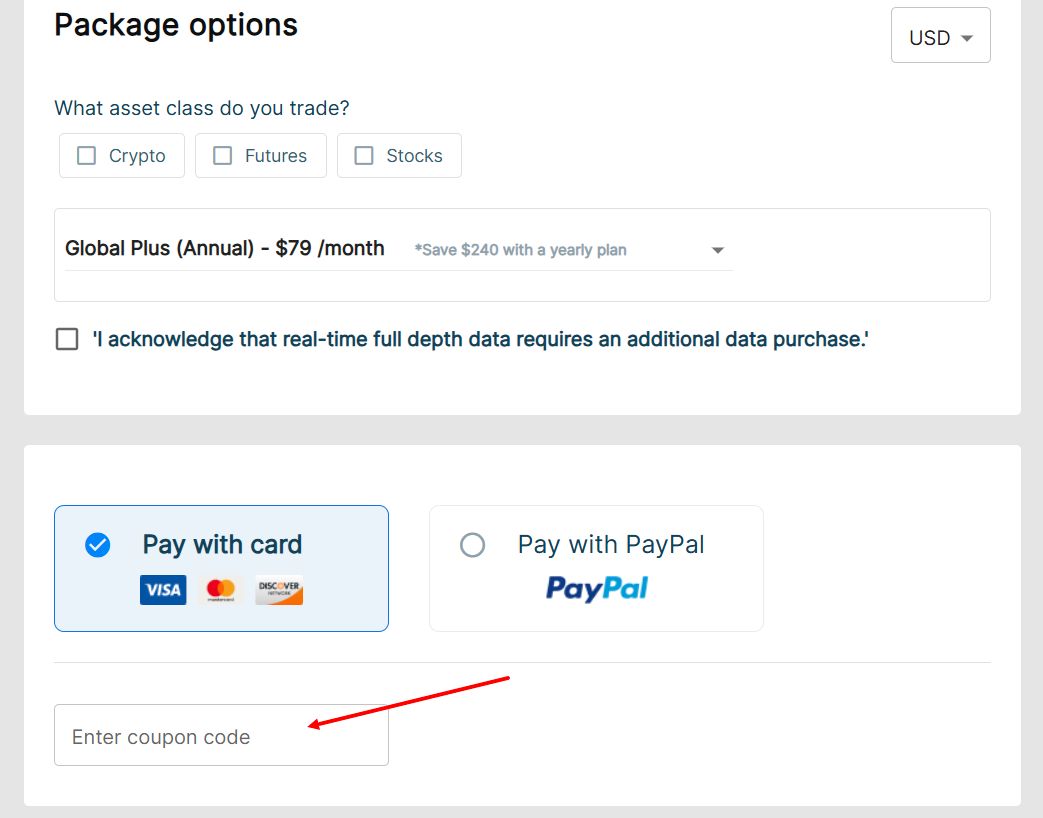
- Locate the "Your Order" section next to your billing details and find the "Coupon" field.
- Click "Enter coupon code" and type your promo code exactly as provided–even minor typos can prevent the discount from going through.
- Click "Apply" and confirm the coupon is accepted before completing payment; the updated total should reflect the discount immediately.
- Only proceed to payment once the adjusted pricing is visible in your order summary and the promo code has been processed correctly.
Current offers
- 4th of July pricing event coming soon: A limited Independence Day rollout is expected to bring short-term price reductions on selected plans, available for a narrow window only.
- Annual plans 20% off: Yearly subscriptions are currently 20% lower than standard pricing–a straightforward discount applied at checkout for users choosing longer-term access over monthly billing.
- First month 50% off on single exchange data access: CME, CBOT, COMEX, and NYMEX feeds come with a 50% discount on the first billing cycle, reducing the entry cost for market-by-order (MBO) data without affecting the ongoing rate.
- MBO Bundle at 25% off: The bundled market-by-order package is available at a 25% reduction, consolidating deeper liquidity and order flow data under one subscription.
Following these through KODOBI makes it easier to keep up with rotating discounts, bundle pricing, and seasonal offers without tracking them across multiple sources.
Strengths and features that set Bookmap apart
Bookmap is built around one core idea that separates it from conventional trading tools: rather than breaking market data into isolated indicators, it presents order flow as a single continuous environment where liquidity and price movement stay visually connected as they develop.
The depth-of-market heatmap is where this becomes tangible–liquidity appears as something active, forming and shifting around price in real time and giving structure to market levels that static displays can't provide.
Executed trades are layered onto the same chart, so market activity and actual fills share one view instead of competing for attention across separate panels.
That consistency extends across crypto, futures, and equities. Traders can move between markets without switching tools or rebuilding their workflow, with one subscription covering multiple use cases.
Volume and liquidity tools add further context without altering the core view–keeping the focus on how the market behaves as a whole rather than on any single isolated metric.
Range of services offered by Bookmap
- Real-time market data visualization: Live order book mapping that makes liquidity shifts easier to read and interpret.
- Trading analytics: Advanced indicators centered on volume and execution behavior.
- Multi-market connectivity: Integration with crypto exchanges, futures markets, and stock data feeds, letting traders manage different asset classes from one place.
- Educational resources: Tutorials and webinars focused on helping users build a working understanding of order flow trading.
Bookmap fits a broader turn in how active traders approach their tools–away from stacked indicators and toward interfaces that surface what's actually happening at the price level. As that preference grows, platforms built around raw data transparency are drawing more serious attention.